
Slit Coils for Solar Structure Manufacturing: Width, Thickness, Grade & Coating Guide
 Practical Notes
Solar mounting structures are manufactured from several steel components, including purlins, rafters and connection members. For cold-formed sections, the quality and specifications of the incoming steel strip can affect the entire manufacturing process.
One important input is the slit coil: a steel coil cut into narrower widths to suit the component being manufactured. Its width, thickness, mechanical properties, coating and edge condition must match the approved production requirements.
A coil may appear suitable because its thickness and coating are correct, but an incorrect strip width or unsuitable steel grade can still create problems during roll forming. Similarly, poor edge quality can affect feeding, handling and the finished component.
This guide explains how to select slit coils for solar structure manufacturing, with practical guidance on width calculation, material thickness, steel grade, protective coatings, tolerances and the information buyers should provide when requesting a quotation.
What Are Slit Coils?
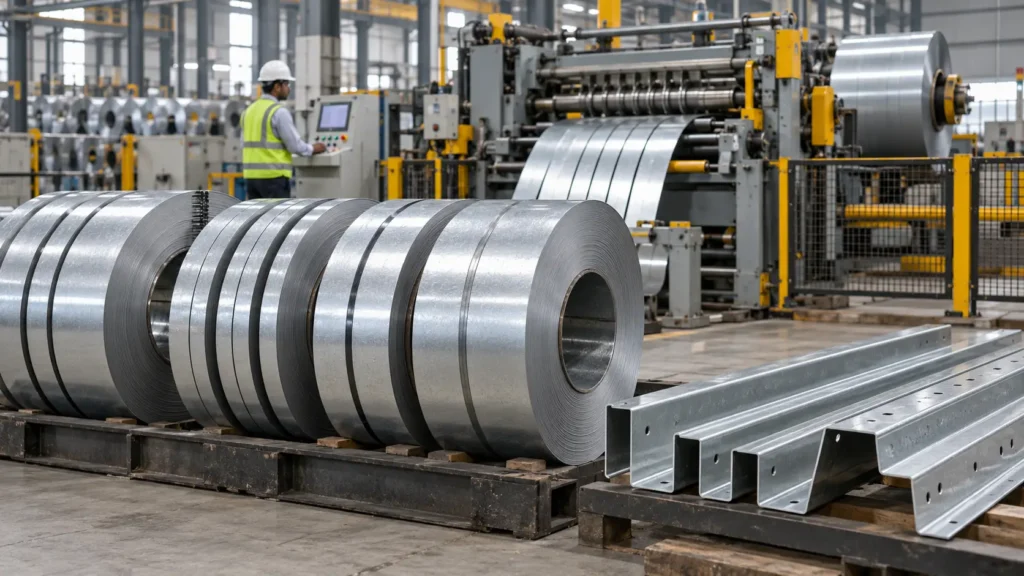
Slit coils are narrow steel strips produced by cutting a wider steel coil lengthwise into smaller widths. The process is known as coil slitting.
During slitting, a wide coil is unwound and passed through a set of rotary cutting blades. These divide the material into narrower strips of specified widths, which are then rewound into individual coils.
The resulting steel slit coils retain the base material and coating characteristics of the original coil, subject to any effects of the cutting and handling process.
Slitting allows steel processors and manufacturers to obtain the strip widths required for particular production operations rather than feeding unnecessarily wide material into a forming line.
Common applications include:
- Cold-formed structural profiles
- Solar mounting structure components
- Industrial purlins and support sections
- Cable tray manufacturing
- Roofing and cladding components
- Electrical enclosures and other fabricated steel products
For solar structures, the required slit-coil specification depends on the profile drawing and the manufacturing process. A strip intended for one component should not automatically be treated as suitable for another.
How Are Slit Coils Used in Solar Structure Manufacturing?
In many solar module mounting structures, cold-formed steel sections are manufactured by passing steel strip through a sequence of forming rollers.
The rollers gradually bend the strip into the required profile. Depending on the approved structural design, these sections may include C purlins, Z purlins or HAT profiles.
A typical manufacturing sequence is:
- Material selection: Choose a steel coil matching the approved grade, thickness and coating specification.
- Coil slitting: Prepare narrow strips according to the developed width required for each profile.
- Roll forming: Feed the strip through suitable tooling to create the specified section.
- Punching and cutting: Produce holes, slots and member lengths according to the approved manufacturing drawings.
- Inspection: Check the finished components against the required dimensions, tolerances and material specifications.
The exact sequence may vary with the equipment, profile and project requirements.
For a broader explanation of the production workflow, read our Solar Module Mounting Structure Manufacturing Guide.
1. Slit Coil Width: Why Developed Width Matters
Width is one of the most important specifications when ordering a slit coil for roll forming.
It determines how much material enters the forming line and influences whether the finished section can achieve the required web, flange and lip dimensions.
What Is Developed Width?
Developed width, sometimes called flat-pattern or blank width, is the width of the flat steel strip required to produce a particular formed profile.
For example, a C purlin includes a web, two flanges and, where specified, two lips. However, the required strip width cannot always be obtained simply by adding the nominal finished dimensions.
The calculation must account for factors such as:
- Profile geometry and the approved drawing
- Steel thickness
- Number and angle of bends
- Inside bend radii
- Bend allowances and the forming method
- Tooling and dimensional requirements
The developed width should therefore come from an approved flat-pattern calculation or the manufacturer’s validated roll-forming setup.
Practical example: Two C purlins may have the same web depth but different flange or lip dimensions. They may consequently require different slit widths, even when manufactured from steel of the same thickness.
Before purchasing slit coils, buyers should confirm the required developed strip width rather than relying only on the finished profile’s nominal size.
Why Is Slit Width Tolerance Important?
Width tolerance defines the permitted variation from the specified strip width.
If the supplied strip is wider or narrower than the agreed range, it may affect material tracking, profile dimensions or forming consistency.
The appropriate tolerance depends on the material, slitting capability, profile design and downstream equipment. There is no single width tolerance that should be assumed for every solar structure application.
For procurement, the purchase order should identify both the nominal slit width and the agreed tolerance, along with any required inspection method.
2. Choosing the Correct Slit Coil Thickness
Steel thickness influences the formed profile’s cross-sectional properties, weight and manufacturing behaviour. It is therefore a design-controlled requirement, not simply a commercial preference.
Different solar structure members may require different material thicknesses depending on their geometry, loading and structural role.
When specifying slit coil thickness, buyers should consider three points.
Match the Approved Structural Design
The material thickness must correspond with the approved component specification. A substitution should not be made solely because another thickness is more readily available.
Any proposed change should be reviewed by the responsible engineering team because it can affect structural capacity, section geometry and connection requirements.
Clarify the Thickness Measurement Basis
For coated steel, the quoted thickness may refer to the base steel or to the overall coated product thickness, depending on the applicable product standard and purchase specification.
These should not be confused. The buyer and supplier must agree on the thickness definition and measurement requirements before ordering.
Confirm Forming Compatibility
Even where the nominal thickness matches, changes in material properties or tolerances can affect roll-forming performance.
The selected steel must be suitable for the required bend geometry and production method.
For finished-section selection, our C Purlin Selection Guide for Solar Structures explains how thickness relates to other component specifications.
3. Steel Grade and Mechanical Properties: What Buyers Should Check
Steel grade is another essential parameter when selecting slit coils for solar structure manufacturing.
Two coils with identical dimensions and coatings may have different mechanical properties. They should not be considered interchangeable without checking the approved material requirements.
Important material properties include:
- Yield strength: The stress level associated with the onset of plastic deformation under the relevant test conditions.
- Tensile strength: The maximum engineering tensile stress reached in a tensile test.
- Elongation: A measure associated with the material’s ductility.
- Formability: The material’s suitability for the bends and forming operations required by the finished profile.
For cold-formed sections, selecting the steel with the highest available strength is not automatically the best decision.
A higher-strength grade may offer different forming characteristics. The material must satisfy both the structural specification and the practical manufacturing requirements.
The purchase order should therefore state the exact steel grade and applicable material standard, rather than using a broad description such as “high tensile steel”.
Where required, the buyer should also request the relevant material test certificate to verify the supplied grade and mechanical properties.
4. Galvanized, GP and Zincalume Slit Coils: Understanding Coating Options
Solar mounting structures are exposed to outdoor environmental conditions. Corrosion protection is therefore an important consideration when selecting steel materials.
Several coated steel products can be supplied in slit-coil form. However, their suitability for a particular solar component depends on the project specification and approved manufacturing route.
GP Slit Coils
GP slit coils, or Galvanized Plain slit coils, are steel strips with a protective zinc coating.
They are commonly associated with galvanized steel processing and applications requiring a specified combination of thickness, width and corrosion protection.
When purchasing a galvanized slit coil, buyers should identify the applicable steel grade, zinc coating designation and product standard instead of relying on the term “GP” alone.
Galvanized Slit Coils
The expression galvanized slit coil generally refers to steel strip cut from galvanized coil stock.
These products may be considered for roll-formed components where the approved specification permits the use of pre-coated steel.
Because slitting creates new edges, the required treatment or acceptance of exposed cut edges should be considered. The coating’s suitability also depends on subsequent bending, punching, handling and the intended environment.
Zincalume and Aluminium-Zinc Coated Slit Coils
Zincalume is an aluminium-zinc coated steel product. Its coating composition and performance characteristics differ from those of conventional zinc-coated steel.
Aluminium-zinc coated material may be used in suitable industrial applications, but it should not be treated as a direct substitute for galvanized steel without checking the project specification.
When comparing coated products, buyers should verify the coating type, coating mass designation, relevant standard, material grade and fabrication suitability.
Colour-Coated Slit Coils
Colour-coated slit coils are manufactured from prepainted steel material. The metallic coating and paint system provide a finish specified for the intended application.
These coils are relevant to various roofing, cladding and industrial fabrication applications. Their use for any particular solar mounting structure component must be confirmed against the approved design and coating requirements.
Shree Deepak Industries lists GP, Zincalume and colour-coated slit coils among its steel product offerings.
Important: Coating descriptions such as zinc, aluminium-zinc and colour-coated steel are not interchangeable. The correct finish should be selected against the relevant product standard and project requirements.
5. Slit Coil Quality: Width Tolerance, Burrs, Camber and Surface Condition
Choosing the correct steel grade and coating is only part of slit coil procurement. The physical condition of the strip also matters.
Quality issues originating during slitting, recoiling, handling or storage may affect downstream processing.
| Quality Parameter | What It Means | Why It Matters |
| Slit width tolerance | Variation from the specified strip width | Can affect feeding and final profile dimensions |
| Edge burr | A raised or rough lip left at a cut edge | Can create handling risks or interfere with processing |
| Camber | Sideways curvature of the strip along its length | Can affect tracking through downstream equipment |
| Coil set | Residual curvature of strip after uncoiling | May affect strip handling and feeding |
| Telescoping | Sideways displacement of coil wraps | Can complicate storage, uncoiling and handling |
| Coating condition | Scratches, visible damage or other coating defects | Can affect the specified surface and corrosion-protection requirements |
The permitted values and acceptance methods should be agreed before supply. Generic claims such as “perfect edges” or “zero tolerance” are not substitutes for a measurable specification.
Why Does Edge Quality Matter for Roll Forming?
During roll forming, a narrow steel strip passes through multiple forming stations. The quality of its edges can influence material handling and the interaction between the strip and the production equipment.
Excessive burrs or damaged edges can create problems during feeding and subsequent fabrication. Similarly, significant camber can cause the strip to track unevenly.
Inspection requirements should therefore reflect the downstream application, not just the visual appearance of the finished coil.
6. What Should Buyers Specify When Ordering Slit Coils?
A clear purchase specification helps the supplier identify the required steel material and processing parameters.
For a solar structure manufacturing order, the following information should be considered:
| Specification | Information to Share |
| Application | Solar purlin, structural profile, cable tray or other component |
| Material grade | Exact grade and applicable steel standard |
| Thickness | Nominal thickness, measurement basis and agreed tolerance |
| Slit width | Required developed strip width and tolerance |
| Coating | Metallic coating type, designation and applicable standard |
| Edge condition | Permitted burr, edge quality and any treatment requirements |
| Strip shape | Agreed camber or other shape tolerances, where necessary |
| Coil configuration | Required inside diameter, weight limits and handling requirements, where applicable |
| Quantity | Required quantity for each width and material specification |
| Documentation | Material certificates, inspection records and identification requirements |
| Delivery | Destination, required schedule and packaging conditions |
Not every order requires the same level of detail. However, any parameter that affects downstream manufacturing should be confirmed rather than left to assumption.
For example, a request stating only “galvanized slit coil, 1.5 mm” is incomplete for many roll-forming applications. It does not establish the exact steel grade, width, coating requirement or acceptable dimensional variation.
7. Common Mistakes When Selecting Slit Coils for Solar Structures
Ordering by Thickness Alone
Correct thickness does not guarantee that the steel has the required mechanical properties or coating. Grade, width and the applicable product specification also matter.
Using Finished Profile Dimensions as the Slitting Width
The flat-strip requirement must account for the developed profile geometry and forming allowances. Using only the visible finished dimensions can result in the wrong slit width.
Assuming All Galvanized Coils Are Equivalent
Different galvanized materials can have different coating designations, steel grades and processing requirements. The coating specification should be identified explicitly.
Ignoring Slit-Edge Quality
A strip can meet its nominal width and still have excessive burrs, camber or surface damage. Edge and shape requirements should be included where they affect production.
Changing Material Grade Without Design Approval
Replacing one steel grade with another may affect both structural properties and formability. Substitutions must be evaluated against the approved component specification.
Slit Coils for Solar Structures from Shree Deepak Industries
Shree Deepak Industries, based in Jaipur, Rajasthan, offers steel products for solar mounting structures and industrial manufacturing applications.
Its slit coil product range includes GP, Zincalume and colour-coated options, with specifications varying by product and requirement.
The company’s related offerings also include steel coils, C purlins and HAT purlins for relevant structural and industrial applications.
When requesting slit coils for a solar structure project, buyers should share their required material grade, width, thickness, coating specification, quantity and delivery location. Available combinations and processing requirements can then be discussed against the project needs.
Need slit coils for solar structure manufacturing? Contact Shree Deepak Industries with your material specification and quantity to discuss suitable product options and request a quotation.
Frequently Asked Questions
What is a slit coil in steel manufacturing?
A slit coil is a narrow steel strip produced by cutting a wider coil lengthwise. The resulting strips can be used in roll forming, fabrication and other manufacturing processes requiring specific material widths.
Which slit coils are used for solar mounting structures?
Suitable slit coils depend on the approved solar structure design. The required steel grade, thickness, developed width, coating and tolerances vary according to the component and manufacturing process.
What is the difference between a steel coil and a slit coil?
A steel coil is supplied as a continuous roll of steel strip. A slit coil is a narrower roll produced by longitudinally cutting a wider parent coil into specified widths. Slitting changes the strip width but does not intentionally change the steel’s grade or nominal thickness.
What is a GP slit coil?
A GP slit coil is a narrow steel strip produced from Galvanized Plain steel coil. It has a zinc-coated surface, and its exact grade, coating mass, thickness and width should be established by the applicable material specification.
How is slit coil width calculated for C purlins?
The required slit width is based on the developed flat width of the C-section. The calculation considers the section geometry, steel thickness, bend radii and forming allowances. The final width should be validated against the approved profile drawing and production tooling.
Why are burr and camber important in slit coils?
Burrs are raised imperfections along cut edges, while camber describes sideways curvature of the strip. Excessive burr or camber can interfere with handling, feeding and downstream manufacturing. Acceptable limits should be agreed for the intended application.
Can galvanized slit coils be used directly for roll forming?
Yes, where the material, coating, dimensions and mechanical properties are suitable for the specified forming process. The manufacturer must also consider bend geometry, coating condition and any subsequent cutting or punching operations.
Conclusion
Selecting the right slit coil for solar structure manufacturing involves more than choosing a steel strip of the required thickness.
The developed width must suit the finished profile, the steel grade must match the approved material specification, the coating must meet the project’s protection requirements, and the slit edges must be suitable for downstream processing.
For EPC procurement teams and solar structure manufacturers, clear material specifications and agreed tolerances help reduce avoidable production problems and ensure that incoming steel is aligned with the intended application.
Before ordering, confirm the width, thickness, grade, coating and quality requirements for each component. These details provide a stronger starting point for consistent manufacturing and reliable project supply.
Share thickness + size + quantity — we’ll reply with the best option.