
Solar Structures for Rajasthan Projects: Sand, Wind, Corrosion & Dispatch Planning from Jaipur
 Practical Notes
Rajasthan is an important location for solar power development, with projects planned across different terrains, climates and site conditions. For solar EPC companies and procurement teams, these differences matter when specifying and sourcing the steel components used in module mounting structures.
A solar project in western Rajasthan may face different dust, sand and wind exposure conditions from a project closer to Jaipur or another part of the state. Even within the same district, terrain, soil conditions and the arrangement of surrounding structures can influence project requirements.
For this reason, sourcing a solar structure in Rajasthan involves more than selecting a standard galvanized steel profile. The structural design, corrosion-protection requirements, fabrication drawings, material schedule and delivery sequence must all correspond to the actual project.
Manufacturing coordination is equally important. If an EPC requires large quantities of C purlins, HAT purlins or other steel sections, the material must be identified, produced and dispatched in a way that supports the planned installation sequence.
This guide explains the practical considerations for solar mounting structure procurement in Rajasthan, including sand and dust exposure, wind requirements, corrosion protection, steel profile specifications and dispatch planning from Jaipur.
Why Do Solar Projects in Rajasthan Need Site-Specific Planning?
Rajasthan includes arid and semi-arid regions, urban and industrial areas, agricultural land and locations with differing terrain and exposure conditions.
It would therefore be incorrect to apply one environmental or structural specification to every solar project across the state.
For ground-mounted solar installations, the project engineering team must consider the conditions at the actual site. These can influence the design of the mounting structure, its foundations, the protective coating system and the construction plan.
Before manufacturing begins, EPC teams should establish:
- The confirmed site location and relevant exposure conditions.
- The approved module mounting structure layout.
- Project-specific wind and other structural design requirements.
- Steel grades, member dimensions and material thicknesses.
- Required corrosion-protection and coating specifications.
- Fabrication drawings, hole patterns and connection details.
- Material quantities and the planned delivery sequence.
These details help ensure that the requested steel components correspond to the approved design rather than a general assumption about solar projects in Rajasthan.
1. Sand and Dust: What Should Solar Structure Buyers Consider?
Sand and dust are important environmental considerations in some Rajasthan solar project locations, especially in exposed and arid areas.
However, it is useful to distinguish between their effects on solar modules and their implications for steel mounting structures.
Dust accumulation on photovoltaic modules can affect light transmission and energy generation. For steel mounting structures, the more relevant considerations include exposure to windblown particles, surface condition, maintenance access and handling of components during construction.
Windblown Sand and Coating Exposure
At sites with significant windblown sand, exposed surfaces may experience abrasive action. The extent of any effect depends on particle characteristics, wind conditions, component position and the protective coating system.
This does not mean that every Rajasthan solar structure needs a special coating solely because it is located in the state.
The EPC should identify whether the site has unusual abrasive exposure and communicate any additional protective requirements through the approved project specification.
Dust During Storage and Installation
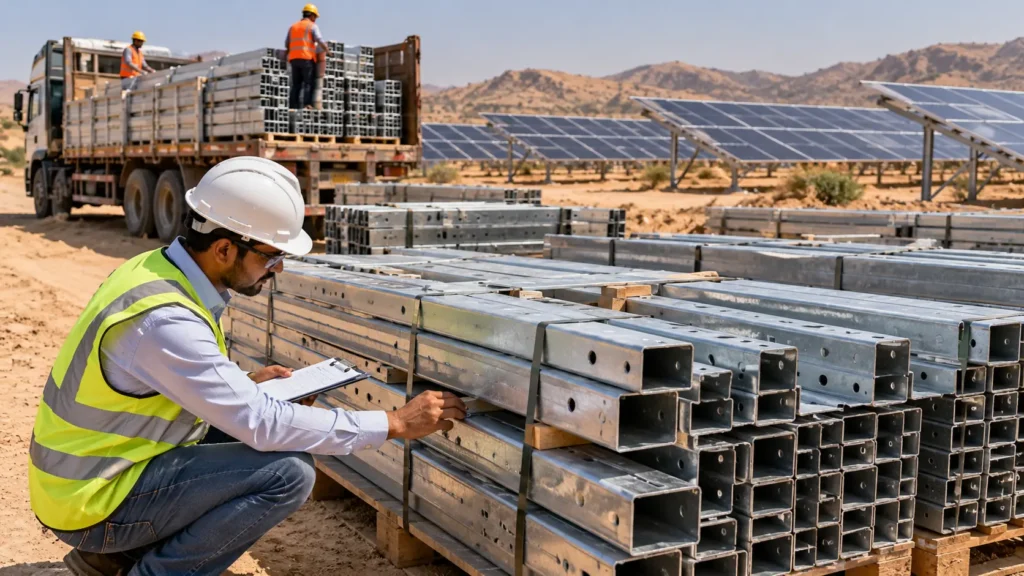
Steel members may remain temporarily stored at a construction site before installation. In dusty locations, suitable handling and storage arrangements help protect components from avoidable damage and contamination.
Practical considerations include:
- Keeping bundles identified and organized.
- Using suitable storage supports instead of placing finished members directly on uneven ground.
- Avoiding unnecessary dragging or impact during handling.
- Checking for coating damage before installation.
- Keeping connection surfaces and holes suitable for the specified assembly procedure.
The site contractor should establish appropriate storage and handling procedures for the actual conditions and supplied materials.
Access for Inspection and Maintenance
Solar mounting structures should allow the maintenance and inspection activities required by the approved system design.
Locations where debris or dust tends to accumulate may require attention during routine site maintenance. The inspection method and frequency should follow the project’s maintenance requirements.
Procurement takeaway: Tell the manufacturer about unusual environmental conditions, but do not change the approved structural section or coating specification without engineering review.
2. Wind Exposure: What Must Be Confirmed Before Fabrication?
Wind is a critical design consideration for solar mounting structures because solar modules and their supporting members are exposed to pressure and uplift forces.
For Rajasthan projects, the design wind actions must be established for the specific site and mounting configuration.
India’s IS 875 (Part 3):2015, together with applicable amendments and other relevant design requirements, provides a code framework for wind loads on buildings and structures.
However, a basic wind-speed value does not independently establish the forces acting on every solar module mounting structure. The responsible structural engineer must determine the applicable design basis and load effects.
Why Location Alone Is Not Enough
Two projects in Rajasthan may have different wind-loading requirements because of factors such as:
- Geographical location.
- Terrain and surrounding exposure.
- Relevant design height and geometry.
- Module inclination and arrangement.
- Structural configuration and support conditions.
- Applicable design criteria and load combinations.
Engineers must also consider how the calculated forces transfer through the modules, connections, purlins, rafters, other structural members and foundations.
For procurement teams, the important point is that the required steel member dimensions and grades must be derived from the approved design.
What Should Be Finalised Before Manufacturing?
Before requesting fabrication of purlins or other mounting structure components, the EPC should confirm that the manufacturing documents reflect the approved structural requirements.
Relevant information includes:
- Final structural member sizes and profiles.
- Specified steel grade and thickness.
- Member lengths and required quantities.
- Hole and slot dimensions.
- Connection and support details.
- Approved drawing revisions.
A manufacturer should not be expected to determine the site’s wind loads from the delivery address alone or to substitute a different profile without the appropriate engineering approval.
Important: This guide is about procurement coordination, not wind-load calculation. Project-specific structural design must be performed or approved by the responsible qualified engineering professional.
3. Corrosion Protection for Rajasthan Solar Structures
Solar mounting structures generally operate outdoors, so corrosion protection is an important part of material specification.
Galvanized steel is commonly used for solar structure components because a suitable zinc coating can protect the underlying steel against corrosion.
However, the correct coating type and requirement cannot be determined from the word “Rajasthan” alone.
Understand the Actual Site Exposure
Corrosion conditions may vary depending on moisture, atmospheric pollutants, soil chemistry, salts and other local factors.
Although many locations in Rajasthan experience dry conditions, that does not eliminate corrosion risk. Conversely, a hot or dusty climate does not automatically require the same protective system at every site.
Any project-specific corrosion assessment should inform the coating specification.
Specify the Coating Clearly
When requesting galvanized steel profiles, the procurement team should identify:
- The required coating system or material finish.
- The applicable coating standard.
- Coating mass or thickness requirements, as applicable.
- Whether coating is applied before or after fabrication, where relevant.
- Any approved requirements for cut edges, punched holes or coating repair.
The term “hot-dip galvanized” should be used carefully because continuous coil galvanizing and galvanizing after fabrication are different production routes.
Similarly, a coating value in GSM should not be directly treated as equivalent to a micron value without understanding the material and measurement basis.
Protect the Coating During Transportation and Handling
Even when the correct protective coating has been specified, handling damage may affect the condition of the delivered material.
Bundling, loading, unloading and temporary storage should therefore be planned to limit unnecessary scratches, deformation and other damage.
Any coating repairs or acceptance decisions should follow the applicable project specification.
Procurement takeaway: Select the coating against the project’s exposure requirements and ensure that fabrication, packaging and handling are compatible with the specified finish.
4. Selecting Steel Profiles for Solar Mounting Structures in Rajasthan
Solar mounting structures in Rajasthan may use different combinations of purlins, rafters, posts, bracing and connection components, depending on the design.
There is no single steel profile that is correct for every solar installation.
For projects using cold-formed sections, commonly specified profiles include C, Z and HAT purlins.
C Purlins
C-shaped cold-formed sections may be specified for module-supporting or other structural applications within a solar mounting system.
The approved drawings should define the complete profile, including the web, flange, lip, thickness, length and connection requirements.
Buyers can review the C Purlin range from Shree Deepak Industries for relevant product information.
HAT Purlins
HAT sections have a different cross-sectional geometry and connection arrangement from C sections. They may be used as module-supporting members in suitable structural designs.
The required shape and dimensions should come from the approved engineering documentation.
Explore the company’s HAT Purlin product range.
C and Z Sections
C and Z profiles may be used in various steel structural applications, with their selection depending on the required section properties and connections.
For relevant profiles, see the C and Z Purlin product page.
Why Project Drawings Matter More Than Standard Profile Names
A request for “galvanized solar purlins” does not fully define the manufacturing requirement.
Two members with the same nominal profile name may differ in:
- Cross-sectional dimensions.
- Material thickness and grade.
- Finished length.
- Punching and slot positions.
- Coating requirements.
- Connection orientation.
For Rajasthan projects, as elsewhere, the appropriate profile must follow the approved structural design rather than a generic recommendation based on location.
Our existing Ground Mounted Solar Structure Guide explains the broader structural components and design considerations.
5. Dispatch Planning from Jaipur: What EPC Procurement Teams Should Know
Once the steel specifications are finalized, the next challenge is coordinating manufacturing and material delivery with the construction schedule.
For projects sourcing steel profiles from a solar structure manufacturer in Jaipur, dispatch planning should begin before all components are ready to leave the facility.
It is particularly relevant when multiple profile types, member lengths and punching patterns are being supplied to the same project.
Confirm the Delivery Destination
The buyer should share the exact delivery destination, site contact information and any applicable access requirements.
Transport planning may depend on the location, road conditions, permitted vehicle access, available unloading arrangements and other logistics constraints.
A manufacturing location in Jaipur does not, by itself, establish a guaranteed transport time to another Rajasthan location.
Plan Dispatch Against Site Readiness
A completed production batch is not always ready for delivery from the site’s perspective.
For example, an EPC may be preparing foundations or primary steelwork while a separate team is scheduled to install module-supporting members later.
The project team should coordinate dispatch requirements with actual site readiness so that components are not delivered without an appropriate unloading or storage plan.
Use Phased Deliveries Where the Project Requires Them
For a project with multiple construction blocks, material may be requested in stages.
When phased dispatch is agreed, each delivery should be connected to a defined portion of the material schedule.
This can help site teams understand which items are arriving and where they belong.
Whether staged supply is feasible depends on the manufacturer’s agreed production and commercial arrangements.
Coordinate Packaging and Bundle Identification
Steel members may look similar even when their lengths, hole patterns or drawing revisions differ.
Identifying bundles by component code, quantity and other agreed information can support site-level material reconciliation.
Suitable bundling and handling arrangements can also help limit avoidable transport damage.
6. Sample Dispatch Planning Format for Solar Structure Components
The following is an illustrative dispatch coordination format. It is not a record of an actual Shree Deepak Industries project.
| Information | What the EPC and Manufacturer Should Confirm |
| Project reference | Agreed project name or identification code |
| Site / installation block | Area where the material is intended to be used |
| Component code | Part number matching the approved BOM and drawing |
| Drawing revision | Revision released for manufacturing |
| Profile and length | Exact member specification |
| Dispatch quantity | Number of pieces or agreed quantity unit |
| Bundle identification | Agreed label or bundle reference |
| Required dispatch date | Planned date, subject to supplier confirmation |
| Delivery destination | Confirmed site address and unloading point |
| Site contact | Person responsible for receiving the shipment |
A schedule like this can make dispatch discussions more precise than a general request to “send the remaining solar structure material”.
It also helps distinguish manufacturing completion, dispatch and physical receipt at the project site, which are separate milestones.
7. Common Supply and Logistics Mistakes to Avoid
Requesting Material Without Final Drawings
If profiles are manufactured against superseded drawings, even a small change in hole position or member length can create repeated installation problems.
The manufacturer should receive the correct approved drawing revision before production.
Mixing Different Members Without Clear Identification
Bundles containing similar-looking components can be difficult to reconcile if part codes and quantities are not identifiable.
The project team should agree on practical identification requirements before dispatch.
Assuming All Locations Have Similar Access Conditions
Delivery arrangements for an industrial site with established road access may differ from those for a remote construction location.
Transport and unloading conditions should be confirmed rather than inferred from the district name alone.
Changing Quantities Late Without Reviewing the Schedule
A change in required quantity, drawing revision or delivery priority can affect manufacturing and dispatch coordination.
The buyer should communicate changes promptly and seek confirmation of their implications.
Ignoring Site Storage Requirements
Large quantities of finished steel may need temporary storage before installation.
The EPC should make appropriate arrangements for unloading, identification, protection and handling at the receiving site.
8. What Should EPCs Share with a Solar Structure Manufacturer in Jaipur?
For a solar structure procurement enquiry, the most useful information is the approved manufacturing requirement together with the delivery plan.
Before requesting a quotation, prepare the following:
- Project location: State, district, delivery point and any relevant site access conditions.
- Supply scope: Exact steel profiles or components being requested.
- Approved drawings: Profile dimensions, member lengths, hole patterns and drawing revisions.
- Material specification: Steel grade, thickness, coating and applicable standards.
- Bill of Materials: Item-wise quantities and component identification codes.
- Environmental requirements: Any project-specific exposure or corrosion-protection conditions included in the approved specification.
- Delivery schedule: Required dates, installation phases and any agreed dispatch priorities.
- Quality documentation: Relevant certificates, inspection records and acceptance requirements.
- Commercial information: Quantity basis, delivery terms and quotation deadline.
The more clearly these inputs are defined, the easier it becomes for the manufacturer to assess product suitability, manufacturing feasibility and delivery requirements.
9. Solar Structure Manufacturing and Supply from Shree Deepak Industries, Jaipur
Shree Deepak Industries is a steel profile manufacturer based in Jaipur, Rajasthan, with a product range serving solar module mounting structures and industrial applications.
The company manufactures C, Z and HAT purlin profiles and offers related steel products, including slit coils and coated steel coils.
For project-specific requirements, buyers can review the product catalogue and share their approved drawings, material requirements, quantities and delivery location.
Shree Deepak Industries’ stated manufacturing process includes profile-specific production, dimensional checks, bundling and dispatch coordination. Actual product availability, specifications, production schedules and supply terms must be confirmed for each enquiry.
For EPC companies sourcing components for solar projects in Rajasthan, working from a clear manufacturing schedule can help align procurement discussions with the site’s construction requirements.
Planning a solar structure project in Rajasthan? Contact Shree Deepak Industries with your component drawings, steel specifications, quantities and delivery details to discuss manufacturing requirements and request a quotation.
Frequently Asked Questions
What should EPCs consider when sourcing solar structures in Rajasthan?
EPCs should consider the approved structural design, location-specific exposure conditions, steel grade and coating requirements, component drawings, quantities and delivery arrangements. Manufacturing specifications should be based on the actual project rather than general assumptions about Rajasthan.
Do solar mounting structures in Rajasthan need special protection against sand?
Not every project requires a special coating because of sand. Sites with significant windblown particles may have additional exposure considerations, but the protective system should follow the approved environmental assessment and project specification.
Are wind-load requirements the same across Rajasthan?
No. Wind design requirements depend on the site location, terrain, structural configuration and applicable design criteria. The responsible structural engineer must establish the loads and approve the mounting structure design.
Which steel profiles are used for solar mounting structures?
Depending on the approved structural design, solar mounting structures may use C, Z or HAT sections and other fabricated steel components. The correct member size, thickness, grade and connection arrangement must be specified for the particular project.
Why is corrosion protection important for Rajasthan solar projects?
Solar structures operate outdoors and may be exposed to moisture, atmospheric conditions and other local corrosion factors. A suitable protective coating helps protect steel components, but the coating type and specification should match the assessed site conditions and project requirements.
Can solar structure components be dispatched from Jaipur to other locations in Rajasthan?
A Jaipur-based manufacturer may supply components to different project locations, subject to the agreed order, transport arrangements and delivery feasibility. The buyer should confirm the destination, quantity, access conditions and required schedule before finalizing the supply arrangement.
What information is needed to request a solar structure quotation?
Buyers should provide approved drawings or a component schedule, steel grades, thicknesses, coating requirements, quantities, any special fabrication details and the delivery location. A phased delivery requirement should also be communicated where applicable.
Does Shree Deepak Industries manufacture or install complete solar power plants?
Shree Deepak Industries’ website focuses on manufacturing and supplying steel profiles and related products used in solar mounting structures. Any requirement beyond the stated product supply scope should be discussed separately rather than assumed to be included.
Conclusion
Successful solar structure procurement for Rajasthan projects depends on aligning the manufactured steel components with the actual engineering and site requirements.
Sand and dust exposure, wind loading and corrosion conditions require project-specific evaluation. Meanwhile, the quality of the procurement documentation, accuracy of fabrication drawings and coordination of material dispatch can influence how smoothly supplied components move from manufacturing to installation.
For EPC companies sourcing solar mounting structure profiles from Jaipur, the practical approach is to confirm the approved structural and material specifications, provide a clear component schedule and coordinate dispatch according to site readiness.
With these requirements established in advance, manufacturers and procurement teams can work from a clearer scope and reduce avoidable misunderstandings during production and delivery.
Share thickness + size + quantity — we’ll reply with the best option.