
GI vs Galvalume vs Colour Coated Steel Coil: Which to Use for Roofing & Industrial Sheds
 Practical Notes
Choosing steel for an industrial shed roof involves more than selecting a sheet thickness or comparing prices. The type of metallic coating, paint finish, site environment and forming requirements can all affect how the finished roofing material performs.
Three terms frequently appear in roofing material enquiries: GI, Galvalume and colour-coated steel. Although they are often discussed as separate options, they do not describe three equivalent coating systems.
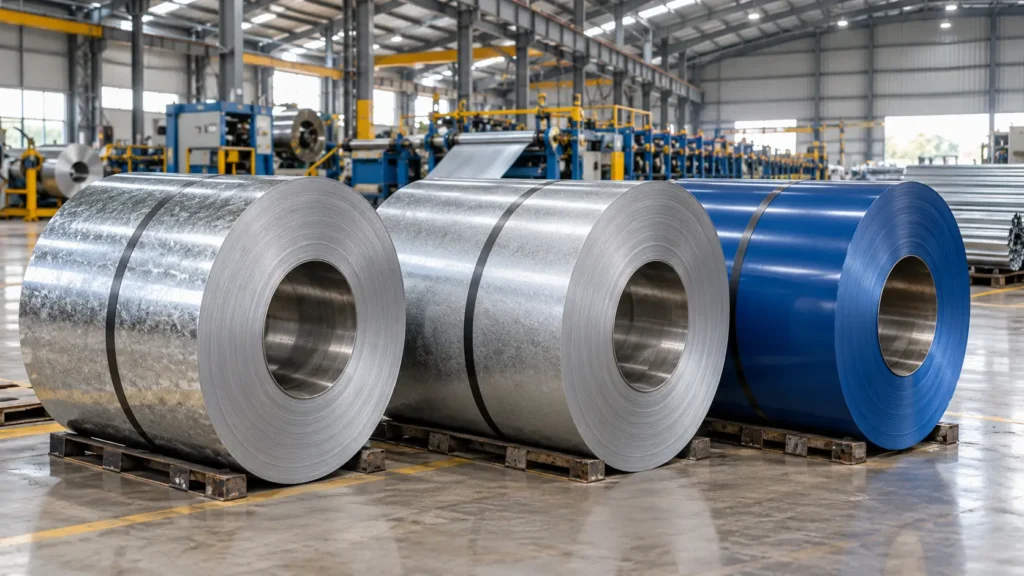
GI steel generally has a zinc coating. Galvalume steel uses an aluminium-zinc alloy coating. Colour-coated steel adds a paint system over a suitable metallic-coated substrate, which may be GI or Galvalume.
For contractors, industrial building owners and steel procurement teams comparing GI vs Galvalume, understanding these differences helps identify the material specifications needed for roofing, wall cladding and other industrial applications.
This guide explains the main coating types, the difference between PPGI and PPGL, how they are used for industrial roofing, and what buyers should check before ordering steel coils.
What Is a GI Steel Coil?
GI stands for Galvanized Iron, a commonly used trade term for zinc-coated steel. A GI coil is generally manufactured by applying a protective zinc coating to steel strip.
In continuous hot-dip galvanizing, the steel strip passes through a molten zinc bath. The coated material is then processed and supplied in coil form.
The zinc layer helps protect the steel against corrosion. It provides a physical barrier and can also offer sacrificial protection where steel becomes locally exposed.
GI coils are used in many industrial applications, including:
- Roofing and cladding sheets.
- Cold-formed building components.
- Industrial enclosures and ducting.
- Fabricated steel products.
- Other applications requiring a specified zinc-coated steel substrate.
For roofing applications, the required zinc coating mass, steel grade and base metal thickness should be selected according to the applicable product specification.
The description “GI coil” alone does not establish these requirements.
What Is a Galvalume Steel Coil?
Galvalume is a trade name commonly associated with steel coated using a 55% aluminium-zinc alloy system.
A typical 55% aluminium-zinc coating contains approximately 55% aluminium, 43.4% zinc and 1.6% silicon by mass.
Unlike conventional galvanized steel, which relies on a zinc-rich coating, Galvalume combines the barrier properties associated with aluminium-rich phases with corrosion protection contributed by zinc.
This makes aluminium-zinc coated steel an important material option for roofing and other suitable industrial applications.
However, its actual corrosion performance depends on the coating specification, exposure conditions, product design and fabrication details.
Why Is Galvalume Used for Roofing?
Aluminium-zinc coated steel is used in roofing because it can provide effective resistance to atmospheric corrosion under suitable conditions.
The coating is also compatible with manufacturing processes used to produce certain roofing and cladding profiles, subject to the steel grade, coating properties and forming requirements.
Galvalume coils may be supplied with an unpainted metallic finish or used as the substrate for a prepainted product.
The buyer should confirm the required coating designation rather than assuming that all Galvalume products offer identical performance.
GI vs Galvalume: What Are the Main Differences?
When comparing GI vs Galvalume steel, the most fundamental difference is the composition of the metallic coating.
| Parameter | GI Steel | Galvalume Steel |
| Metallic coating | Predominantly zinc | Typically 55% aluminium-zinc alloy |
| Primary corrosion-protection characteristics | Barrier protection and sacrificial action from zinc | Barrier protection associated with aluminium-rich phases and protection contributed by zinc |
| Common surface appearance | Silver-grey metallic finish, depending on coating and surface treatment | Silver metallic appearance, depending on coating and surface treatment |
| Common applications | Roofing, cladding, fabrication and other galvanized steel products | Roofing, cladding and other applications suited to aluminium-zinc coated steel |
| Prepainting | Can serve as a substrate for PPGI | Can serve as a substrate for PPGL |
| Cut-edge behaviour | Zinc can provide sacrificial protection to nearby exposed steel | Cut-edge behaviour differs because of the aluminium-zinc coating composition |
| Material selection | Depends on coating class, grade, exposure and fabrication requirements | Depends on coating class, grade, exposure and fabrication requirements |
Important: Neither GI nor Galvalume is automatically the better material in every environment.
A meaningful comparison must consider the actual coating class, steel substrate, processing requirements, local corrosion exposure and the finished roofing system.
What Is a Colour-Coated Steel Coil?
A colour coated coil is a steel coil that has received an organic coating system, such as paint, over a prepared substrate.
For many roofing products, the substrate is already metallic-coated steel. The paint system is then applied through a continuous coil-coating process before the material is formed into the final roofing or cladding profile.
A typical prepainted product can include:
- The base steel substrate.
- A protective metallic coating, such as zinc or aluminium-zinc.
- Surface pretreatment.
- A primer layer.
- A finishing paint layer on the exposed side.
- A suitable coating system on the reverse side.
The exact coating arrangement varies with the product and its intended application.
Colour-coated steel is widely used where both the protective system and the finished appearance matter, including industrial roofs, factory buildings, warehouses and wall cladding.
Paint systems may also be selected for their specified weathering, colour-retention and other performance characteristics.
However, the appearance of the topcoat does not tell a buyer which metallic-coated substrate is underneath.
This is why understanding PPGI vs PPGL is important.
PPGI vs PPGL: What Is the Difference?
PPGI and PPGL are common terms for two types of prepainted steel products.
What Is PPGI?
PPGI stands for Pre-Painted Galvanized Iron.
In practical steel-industry terminology, it usually refers to prepainted steel with a galvanized zinc-coated substrate.
The metallic zinc coating provides corrosion protection beneath the paint system.
What Is PPGL?
PPGL commonly refers to prepainted Galvalume or aluminium-zinc coated steel.
It uses an aluminium-zinc coated substrate beneath the specified paint system.
Although PPGI and PPGL can have similar visible colours and surface finishes, their underlying metallic coatings are different.
PPGI vs PPGL Comparison
| Feature | PPGI | PPGL |
| Full description | Prepainted galvanized steel | Prepainted aluminium-zinc coated steel |
| Metallic-coated substrate | Zinc-coated steel | Aluminium-zinc alloy coated steel |
| Paint finish | Available with specified colour and coating systems | Available with specified colour and coating systems |
| Industrial roofing use | Suitable where the approved specifications permit | Suitable where the approved specifications permit |
| Key selection considerations | Zinc coating, paint system, forming and exposure requirements | Aluminium-zinc coating, paint system, forming and exposure requirements |
It would be incorrect to claim that PPGL always lasts longer than PPGI or that PPGI is always more economical.
The outcome depends on the metallic coating class, paint chemistry, coating thickness, environment, manufacturing quality and maintenance conditions.
GI vs Galvalume vs Colour-Coated Steel: Which Is Suitable for Industrial Roofing?
The right material for an industrial shed roof depends on how the building will be used and the performance requirements established for the roofing system.
The following scenarios illustrate how buyers can approach the selection.
1. When an Unpainted Metallic Finish Is Acceptable
If the project does not require a specific decorative colour, unpainted metallic-coated steel may be considered.
Both GI and aluminium-zinc coated steel are potential options, depending on the exposure conditions, coating requirements and available product specifications.
Instead of assuming that one is always more durable, the buyer should compare the relevant product grades, coating classes and suitability for the roof design.
2. When Building Appearance Matters
Colour-coated steel may be suitable for warehouses, factories, commercial sheds and other buildings where a particular colour or architectural finish is required.
Prepainted products can offer consistent factory-applied finishes in specified colours.
The buyer should establish whether the selected product uses a galvanized or aluminium-zinc coated substrate and confirm the applicable paint specification.
3. When the Site Has Higher Corrosion Exposure
Some buildings operate in environments where moisture, airborne salts, industrial emissions or other local conditions increase corrosion risk.
These conditions should be evaluated before selecting the coating system.
A specification suitable for a relatively mild inland location may not be appropriate for a more aggressive industrial or coastal environment.
Neither Galvalume nor colour coating should be treated as a universal solution for every corrosive setting. The supplier’s application guidance, the selected coating system and any environmental limitations must be reviewed.
4. When Roofing Profiles Require Significant Forming
Industrial roofing sheets are commonly formed from steel coil using suitable roll-forming equipment.
The substrate grade, metallic coating and paint system must be compatible with the required profile and forming process.
Some applications involve bends, ribs or other profile features that can place strain on the coating.
Before ordering, the processor should confirm the minimum forming requirements and the material’s suitability for the intended roofing profile.
5. When Comparing Long-Term Project Costs
Material cost should not be evaluated from coil price alone.
A more useful comparison considers the required steel thickness, coating system, expected exposure, installation details, inspection needs and maintenance considerations.
A product with a lower initial purchase price does not necessarily provide the lowest overall cost for every project.
Similarly, a more expensive coating system is not automatically justified when the intended application does not require it.
Does Galvalume Offer Better Corrosion Resistance Than GI?
Galvalume and GI protect steel through different metallic coating compositions.
Aluminium-zinc coatings can demonstrate strong resistance to surface corrosion in suitable atmospheric conditions, while zinc coatings provide well-established sacrificial protection.
The distinction becomes particularly relevant when the steel is cut, scratched or formed.
Why Are Cut Edges Important?
Cutting steel sheet exposes the base metal along the edge. The surrounding metallic coating influences how that exposed steel behaves under corrosive conditions.
Conventional zinc coatings and aluminium-zinc coatings do not protect exposed edges in exactly the same way.
This is one reason roofing performance should not be judged solely by the appearance or coating mass of a flat, undamaged surface.
Cut edges, fastener holes, sheet laps and other details may require particular attention under the manufacturer’s installation guidance.
Why Site Environment Matters
Atmospheric corrosion depends on several environmental conditions, including time of wetness, airborne salts and pollutants.
For industrial buildings, the local environment and any unusual exposure conditions should therefore be considered when evaluating coating options.
Broad assumptions such as “all coastal projects need Galvalume” or “GI is always better for industrial areas” are not reliable specifications.
What Do Z275, AZ150 and GSM Mean in Steel Coils?
Steel buyers often encounter coating designations when comparing GI and Galvalume products.
GSM means grams per square metre. In relevant continuously coated steel specifications, coating mass designations commonly refer to the total metallic coating mass on both sides of the sheet.
For example:
- Z275: A zinc-coating designation associated with a total coating mass requirement of 275 g/m² under the applicable standard.
- AZ150: An aluminium-zinc coating designation associated with a total coating mass requirement of 150 g/m² under the applicable standard.
These examples are coating designations, not universal requirements for industrial roofing.
Z275 and AZ150 should not be compared simply by subtracting their GSM values. They refer to different coating compositions, which means their density, coating thickness and corrosion behaviour differ.
The specified coating class must also be interpreted using the applicable product standard and its testing requirements.
What About Paint Coating Thickness?
For PPGI and PPGL, the paint coating is a separate part of the protection system.
The thickness of the primer, topcoat and reverse-side coating may be expressed in microns, depending on the product specification.
A complete prepainted-coil specification should identify both the metallic-coated substrate and the organic coating system.
Simply stating “colour-coated coil, 25 microns” may leave important questions unanswered about the substrate, coating layers, paint type and measurement method.
What Steel Thickness Should Be Selected for Industrial Roofing?
The required steel thickness depends on the roofing profile, supporting structure, loads, material grade and project design.
Different steel coil products may be quoted using different thickness conventions.
Two important terms are:
- Base Metal Thickness (BMT): The thickness of the underlying steel without the metallic or paint coatings.
- Total Coated Thickness (TCT): The overall thickness including the applicable coating layers.
These measurements are not interchangeable.
When evaluating roofing materials, the buyer should confirm the thickness basis stated in the drawing, quotation and product specification.
Steel grade and mechanical properties are also important. Two sheets with the same stated thickness may not have identical structural performance.
Roofing capacity and support spacing must follow the approved roofing system design rather than a generic coil thickness recommendation.
Which Indian Standards Are Relevant to Coated Steel Coils?
The relevant product standard depends on the steel substrate and coating system.
Examples of Indian Standards covering different coated-steel products include:
| Indian Standard | Product Category |
| IS 277 | Galvanized steel strips and sheets, including applicable plain and corrugated products |
| IS 15961 | Hot-dip aluminium-zinc alloy metallic-coated steel strip and sheet |
| IS 14246 | Continuously prepainted galvanized steel sheets and strips |
| IS 15965 | Prepainted aluminium-zinc alloy metallic-coated steel strip and sheet |
These standards have different scopes and requirements. They should not be used interchangeably.
Before placing an order, procurement teams should verify the applicable standard, edition, amendments, conformity requirements and product documentation.
The correct standard also depends on whether the material is supplied as unpainted metallic-coated coil or prepainted steel.
What Should Buyers Check Before Ordering GI, Galvalume or Colour-Coated Steel Coils?
For an industrial roofing project, a complete material enquiry helps the supplier identify the required coil product and reduces avoidable misunderstandings.
| Specification | Information to Confirm |
| Application | Industrial roofing, wall cladding, fabrication or another intended use |
| Substrate | Galvanized steel or aluminium-zinc coated steel |
| Steel grade | Specified mechanical grade and relevant material standard |
| Thickness | Nominal thickness, BMT/TCT basis and required tolerance |
| Coil width | Required width and dimensional tolerance |
| Metallic coating | Coating type, class and applicable standard |
| Paint system | Primer, topcoat, reverse-side coating and required performance, where applicable |
| Colour and finish | Specified colour reference, gloss and surface finish, where required |
| Forming requirements | Intended profile, bend requirements and processing conditions |
| Quantity | Required tonnage, coil configuration and order quantity |
| Documentation | Material certificates and applicable conformity or test documents |
| Delivery | Destination, schedule and packaging requirements |
A request such as “colour-coated coil for shed roofing” may not contain enough information for an accurate material comparison.
Providing the required substrate, thickness, coating specification, paint system and quantity gives the supplier a clearer basis for discussing available products.
Common Mistakes When Comparing GI, Galvalume and Colour-Coated Coils
Assuming Colour-Coated Steel Has No Metallic Coating
Many colour-coated products use a metallic-coated steel substrate beneath the paint. Buyers should identify both layers of protection.
Comparing Only Coating GSM
Zinc and aluminium-zinc coating designations cannot be compared by coating mass alone. Their compositions and corrosion characteristics differ.
Ignoring the Paint System
Two coils with the same colour may use different primers, topcoats and reverse-side finishes.
The specified paint system matters for appearance, weathering and suitability for the environment.
Confusing BMT with Total Coated Thickness
Base metal thickness and overall coated thickness refer to different measurements. A purchasing specification must clearly identify which is required.
Choosing Only by Price per Kilogram
Prices may reflect different grades, coating classes, finishes or thicknesses.
Before comparing quotations, confirm that the offered products meet the same requirements.
Assuming Every Roofing Environment Is Similar
Roofing exposed to moisture, industrial pollutants or other aggressive conditions may require a different protective system from roofing in a milder environment.
The selection should be based on the actual exposure and approved project requirements.
GI, Galvalume and Colour-Coated Steel Coils from Shree Deepak Industries
Shree Deepak Industries, based in Jaipur, Rajasthan, offers steel products for construction, fabrication and industrial applications.
Its Steel Coils product range includes galvanized steel coils, Galvalume coils and prepainted coated products.
The listed range includes zinc-coated GP coils, hot-dip galvanized steel coils, prepainted Galvalume coils and other coated steel products.
For projects requiring narrower steel strips for manufacturing, buyers can also explore the company’s Slit Coils product range.
Product availability, brands, grades, coating specifications, dimensions, quantities and pricing should be confirmed for each enquiry.
Need GI, Galvalume or colour-coated steel coils for an industrial roofing project? Contact Shree Deepak Industries with your material specifications, required thickness, coil width, coating type, quantity and delivery location to discuss available options and request a quotation.
Frequently Asked Questions
What is the main difference between GI and Galvalume?
The main difference is the metallic coating. GI steel uses a predominantly zinc coating, while conventional 55% aluminium-zinc coated steel uses an aluminium-zinc alloy. Their protective characteristics differ, so the appropriate choice depends on the application and exposure conditions.
Is Galvalume better than GI for roofing?
Galvalume can provide effective corrosion resistance for suitable roofing applications, but it is not automatically better in every environment. Material selection should consider coating class, site exposure, cut-edge conditions, forming requirements and the approved roofing specification.
What is the difference between PPGI and PPGL?
PPGI generally refers to prepainted galvanized steel, while PPGL refers to prepainted aluminium-zinc coated steel. Both may have similar visible paint finishes, but their underlying metallic coatings differ.
Is colour-coated steel the same as Galvalume?
No. Galvalume describes an aluminium-zinc metallic coating on steel. Colour coating describes an additional organic paint system. Galvalume can be supplied unpainted or with a suitable prepainted finish.
Which steel coil is suitable for factory sheds?
GI, Galvalume, PPGI and PPGL can all be considered for appropriate industrial roofing applications. The correct choice depends on the roof-system specification, environmental conditions, desired finish, steel grade, thickness and coating requirements.
Can GI and Galvalume coils have the same thickness?
Yes, products may be offered with similar nominal steel thicknesses. However, their metallic coating compositions and thickness measurement conventions may differ. The buyer should verify the base metal thickness and applicable product specification.
What is the difference between Z275 and AZ150?
Z275 is a zinc coating designation, while AZ150 is an aluminium-zinc coating designation. Their GSM values refer to different metallic coating systems and should not be used alone to compare corrosion protection or expected service life.
What details should I provide when requesting a steel coil quotation?
Provide the required coil type, steel grade, thickness and measurement basis, width, metallic coating designation, paint finish where applicable, quantity and delivery location. Any project-specific standards and documentation requirements should also be included.
Conclusion
Understanding GI vs Galvalume helps industrial roofing buyers compare steel products based on their actual coating systems rather than appearance or price alone.
GI uses a zinc-based protective coating, while Galvalume uses an aluminium-zinc alloy coating. Colour-coated steel adds another layer of specification through its paint system, with PPGI and PPGL using different metallic-coated substrates.
For warehouses, factories and industrial sheds, the right selection depends on the approved roofing design, steel grade, thickness, corrosion exposure, coating requirements and intended finish.
Before ordering, buyers should compare products using complete technical specifications. This makes it easier to identify suitable steel coils and obtain quotations that reflect the actual project requirements.
Share thickness + size + quantity — we’ll reply with the best option.