
Solar Structure Coating: Pre-Galvanized vs Post-Fabrication Hot-Dip Galvanizing (Micron & GSM Explained)
 Practical Notes
Steel solar mounting structures spend years outdoors, exposed to moisture, temperature changes, dust and other environmental conditions. A protective zinc coating helps reduce corrosion, but specifying “galvanized steel” alone does not tell a manufacturer exactly what the project needs.
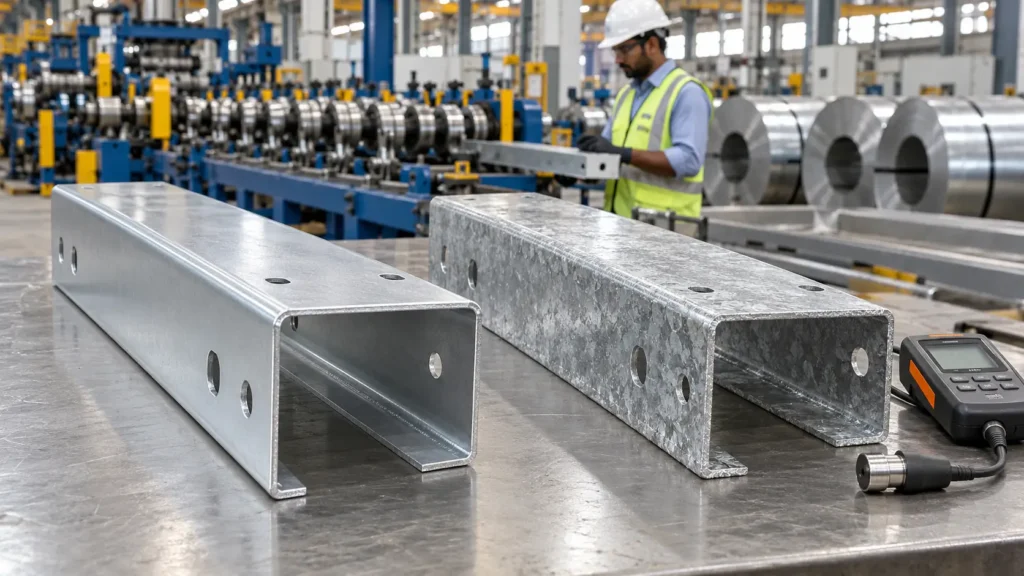
For an EPC or procurement team, an important distinction is whether the steel was coated before the profiles were manufactured or whether the finished components were galvanized after fabrication. Both routes can involve hot-dip galvanizing, yet they differ in processing, treatment of cut edges and welds, applicable standards and coating specifications.
When a project calls for a hot dip galvanized solar structure, the purchase specification should therefore identify the intended galvanizing route rather than relying on the term “HDG” alone.
This guide explains pre-galvanized steel versus post-fabrication hot-dip galvanizing, how coating thickness is expressed in microns and GSM, and what solar EPCs should confirm before ordering C purlins, HAT purlins, rafters and other module mounting structure components.
What Is Pre-Galvanized Steel for Solar Structures?
Pre-galvanized steel is steel that receives its protective metallic coating before it is converted into the final structural component. In a typical continuous hot-dip galvanizing process, a steel strip passes through molten zinc on a processing line. The coated strip is then supplied in coil form for subsequent operations such as slitting, roll forming, cutting and punching.
For solar mounting structures, this manufacturing route is relevant to cold-formed profiles that can be produced from coated steel coils.
The usual process sequence is:
- Steel strip is continuously galvanized.
- The coated coil is slit to the required width, where applicable.
- The strip is roll-formed into the specified profile.
- The profile is cut, punched and finished according to the approved drawing.
Pre-galvanized steel allows the coating specification to be established at the coil procurement stage. This can be practical for repetitive manufacturing of components such as C purlins and HAT purlins, depending on the required coating system and component design.
However, because cutting, punching or welding may take place after the coating is applied, these operations require consideration. Newly exposed steel surfaces and any coating damage must be assessed against the project’s corrosion-protection requirements. Zinc adjacent to a cut edge can provide some sacrificial protection, but it should not be assumed to make every exposed edge acceptable in every environment.
What Is Post-Fabrication Hot-Dip Galvanizing?
Post-fabrication hot-dip galvanizing, sometimes called batch galvanizing, applies the zinc coating after the steel component has been fabricated.
In this route, cutting, drilling, punching and welding are completed before the prepared steel article is immersed in molten zinc. The galvanizing process can then protect accessible surfaces of the finished component, including appropriately prepared cut edges, holes and welded areas.
The typical sequence is:
- Steel members are cut and fabricated according to approved drawings.
- Required holes, connections and welds are completed.
- Components undergo the necessary surface preparation.
- Suitable components are hot-dip galvanized.
- The finished coating is checked against the specified acceptance requirements.
For fabricated assemblies, brackets and other solar structure members, this route may be selected when the project requires zinc coating after the fabrication operations are complete.
It also introduces manufacturing considerations. Component dimensions must suit the galvanizing facility, and suitable venting and drainage arrangements are required where applicable. Thermal effects, dimensional tolerances and the fit of holes or threaded connections may also need attention.
Post-fabrication galvanizing should therefore be considered during component design and production planning, not added as an unreviewed finishing instruction after fabrication.
Pre-Galvanized vs Post-Fabrication Hot-Dip Galvanizing: Key Differences
The main difference between pre galvanized vs hot dip galvanized solar structure components is the stage at which zinc coating is applied.
| Parameter | Pre-Galvanized Steel | Post-Fabrication Hot-Dip Galvanizing |
| Coating stage | Before roll forming and other fabrication operations | After the component is fabricated |
| Typical starting material | Continuously coated steel coil or strip | Fabricated steel article prepared for batch galvanizing |
| Cut edges and punched holes | Created after coating; exposed areas require evaluation | Accessible surfaces are coated after cutting and punching |
| Welded areas | Welding after coating may damage zinc and require treatment | Welds completed before galvanizing can receive a zinc coating |
| Common coating specification | Coating mass, often expressed in g/m² or GSM | Coating thickness, often expressed in microns |
| Relevant standards | Applicable continuous-coated steel standard, such as IS 277 or EN 10346 | Applicable fabricated-article coating standard, such as IS 4759 or ISO 1461 |
| Production considerations | Coil availability, formability, punching and cut-edge requirements | Component geometry, galvanizing access, drainage and dimensional effects |
| Selection basis | Approved project specification, exposure conditions, component design and manufacturing feasibility | |
Important: Neither route is automatically correct for every solar project. A thicker coating is not the only selection criterion, and the coating route should not be changed without reviewing the applicable design and procurement requirements.
What Is GSM in Galvanized Steel?
GSM means grams per square metre (g/m²). In galvanized steel specifications, it describes the mass of coating over a defined surface area.
For continuously zinc-coated sheet, designations such as Z120 or Z275 are commonly used to describe coating mass classes under applicable standards.
For example, under EN 10346, Z275 refers to a nominal coating designation associated with a minimum total zinc coating mass of 275 g/m² across both surfaces under the specified test method.
This distinction matters because the quoted mass generally represents the coating on both sides together, rather than 275 grams on each individual side.
Buyers should not assume that every supplier uses the same convention. A purchase order should identify the coating designation, applicable standard and measurement basis.
What Is Coating Thickness in Microns?
A micron, written as µm, is one-thousandth of a millimetre. It is used to express the physical thickness of a coating.
1 micron = 0.001 mm.
Unlike GSM, which expresses mass per unit area, micron values express the thickness of the protective layer on a surface.
For fabricated steel articles galvanized after fabrication, coating thickness is an important acceptance parameter. The applicable standard may distinguish between local and mean coating thickness and may set different requirements according to the steel article’s thickness and other conditions.
This is why a purchase specification should not simply state “80 microns” without identifying the standard, measurement requirements and relevant acceptance criteria.
GSM vs Microns: How Are They Related?
Coating mass and coating thickness are related through the density of the coating material. For a simple illustration using a pure zinc coating, zinc has a density of approximately 7.1 g/cm³.
That means a zinc layer measuring 1 micron over one square metre of a single surface has a mass of approximately 7.1 grams.
If a continuously coated sheet has zinc distributed equally on both sides, the approximate thickness per side can be estimated using:
Approximate zinc thickness per side (µm) = Total coating mass (g/m²) ÷ (2 × 7.1)
Example: What Does Z275 Mean in Microns?
For a zinc coating mass of 275 g/m² across both sides:
275 ÷ (2 × 7.1) ≈ 19.4 microns per side.
Therefore, a Z275 zinc coating corresponds to approximately 19–20 microns per side when the coating is assumed to be evenly distributed. This is consistent with the approximate theoretical guidance for Z275 in EN 10346.
However, this calculation is an illustration, not a substitute for the specified coating test. Coating distribution may not be identical on both surfaces, and coating designations include test-method requirements.
The calculation should also not be applied without adjustment to other metallic coatings such as aluminium-zinc or zinc-magnesium alloys, which have different compositions and densities.
Can 275 GSM Be Directly Compared with 80 Microns?
Not without clarifying what is being measured.
A Z275 designation for continuously coated sheet ordinarily concerns the total zinc mass across both sheet surfaces. An 80-micron specification for a fabricated article may concern coating thickness measured on an individual surface according to a different standard and sampling method.
These are not equivalent measurement statements. Comparing the numbers without accounting for coating density, measurement area, surface count and the applicable standard can lead to an incorrect material specification.
It is also incorrect to treat 80 microns as a universal requirement for every hot-dip galvanized solar structure. The required thickness must be established for the particular project and applicable standard.
Which Galvanizing Standards Apply to Solar Structure Components?
Solar mounting structures can contain several types of steel components. The relevant coating standard depends on the product form and galvanizing process rather than the fact that the component is used in a solar plant.
IS 277 and EN 10346: Continuously Coated Steel
IS 277 addresses galvanized steel sheets and strips, while EN 10346 addresses continuously hot-dip coated steel flat products intended for cold forming.
These standards are relevant when manufacturing profiles from pre-coated steel strip or coil, subject to the specified material and product requirements.
IS 4759 and ISO 1461: Coatings on Fabricated Steel Articles
IS 4759 concerns hot-dip zinc coatings on structural steel and allied products. ISO 1461:2022 specifies properties and test methods for hot-dip zinc coatings applied to fabricated iron and steel articles.
Importantly, ISO 1461 does not apply to continuously hot-dip galvanized sheet, wire or mesh products. Its requirements should not automatically be imposed on pre-galvanized coil material.
For either route, EPC teams should specify the applicable standard and edition in their approved project documents. The coating requirement should also be consistent with the material specification, fabrication process and intended exposure conditions.
How Should EPCs Choose a Coating for Solar Mounting Structures?
The coating decision should begin with the project’s approved corrosion-protection requirements rather than a general preference for one galvanizing method.
1. Consider the Site Environment
An inland solar installation, a coastal project and a site exposed to industrial pollutants can present different corrosion conditions. Moisture, salts, pollutants and local exposure conditions can influence the required protective system.
Wind and dust may also affect site conditions and maintenance considerations, but they do not independently establish the required zinc coating thickness.
The appropriate coating system should be based on the project’s assessed exposure conditions and specified design requirements.
2. Review the Component and Fabrication Sequence
For roll-formed purlins manufactured from galvanized coil, buyers should establish whether the approved design permits coating before forming and how exposed cut or punched areas are to be handled.
For components requiring welding or more extensive fabrication, galvanizing after fabrication may offer practical advantages by coating accessible finished surfaces. The complete fabrication must still be suitable for the process.
A solar mounting structure can also contain different component types with different coating requirements. One coating route need not apply to every part of the assembly.
3. Confirm Steel Thickness and Material Grade
The steel substrate thickness and the zinc coating thickness are separate specifications.
A 2 mm steel profile does not become a different structural grade simply because it has a heavier zinc coating. Structural performance depends on the approved member geometry, material properties, connection details and design requirements.
For solar purlin procurement, the required material grade, nominal steel thickness and coating class should therefore be stated separately.
Buyers reviewing C-section dimensions and fabrication requirements can also refer to our C Purlin Selection Guide for Solar Structures.
4. Account for Holes, Edges and Assembly Fit
Solar structures frequently use repetitive bolted connections. Hole diameter, slot dimensions, edge distance and positioning must match the approved fabrication drawings.
With pre-galvanized components, punching and cutting may expose steel or affect the surrounding coating. With post-fabrication galvanizing, coating buildup and process-related dimensional effects may influence the fit of close-tolerance connections.
The fabrication drawing and coating process should be coordinated so that the finished components remain suitable for assembly.
5. Confirm Manufacturing Feasibility Before Finalising the Coating Route
Coating selection can influence material sourcing, manufacturing sequence, handling and delivery planning.
Before the purchase order is finalized, the manufacturer should confirm whether the requested profile, material and coating combination is feasible and whether additional fabrication or finishing requirements apply.
What Should Be Included in a Solar Structure Coating Specification?
An EPC or procurement team should provide enough information for the manufacturer to identify the correct material and coating requirements. A practical coating specification may include:
- Component details: C purlin, HAT purlin, rafter, bracket or other MMS part.
- Approved drawings: Profile dimensions, lengths, holes, slots, connections and drawing revisions.
- Base steel specification: Material standard, grade and substrate thickness.
- Coating route: Continuously coated steel before fabrication or hot-dip galvanizing after fabrication.
- Coating requirement: Applicable standard, coating class or required thickness, including the measurement basis.
- Exposure conditions: Environmental classification or project-specific corrosion requirements where provided.
- Fabricated surfaces: Any specified treatment for cut edges, holes, welds or damaged areas.
- Verification requirements: Relevant certificates, inspection method, sampling and acceptance criteria.
These details help establish what must be manufactured and supplied. The broader pre-dispatch checks are covered separately in our Solar Structure Quality Inspection Checklist.
Solar Structure Coating and Manufacturing Support from Shree Deepak Industries
Shree Deepak Industries, based in Jaipur, Rajasthan, manufactures steel profiles for solar module mounting structures and industrial applications, including galvanized C purlins and HAT purlins.
For project-specific requirements, buyers can review our C Purlin and HAT Purlin product ranges and share their approved material, profile and coating specifications.
The applicable coating route, finish, grade, thickness and fabrication requirements should be confirmed for each order before manufacturing. This helps ensure the supplied components are aligned with the project’s approved requirements.
Planning a solar structure procurement? Contact Shree Deepak Industries with your drawings, material specifications, coating requirements, quantities and delivery location to discuss product availability and manufacturing feasibility.
Frequently Asked Questions
What is the difference between pre-galvanized and hot-dip galvanized steel?
Pre-galvanized steel is coated before it is formed or fabricated into the final component. Post-fabrication hot-dip galvanizing coats the fabricated article after operations such as cutting, punching and welding. Both can use molten zinc, but their manufacturing sequence and treatment of fabricated surfaces differ.
Is hot-dip galvanizing better than pre-galvanized steel for every solar project?
No. The appropriate coating route depends on the approved project specification, environmental exposure, component geometry, manufacturing process and required corrosion protection. Neither should be selected solely because one coating number appears higher.
What is the difference between GSM and microns in galvanizing?
GSM expresses coating mass in grams per square metre, while microns express coating thickness. They can be related mathematically for a known coating material, but comparison requires clarity about surface area, coating composition and measurement method.
How many microns is 275 GSM zinc coating?
For pure zinc distributed equally across both faces of a steel sheet, a total mass of 275 g/m² corresponds to approximately 19–20 microns per side. This is an approximate calculation, not an individual product’s measured coating thickness.
Does ISO 1461 apply to pre-galvanized solar purlins?
ISO 1461:2022 applies to hot-dip galvanized coatings on fabricated iron and steel articles. It excludes continuously galvanized steel sheet products. Solar purlins manufactured from continuously coated coil should be specified using the appropriate product and coating standard instead.
What coating thickness is required for solar mounting structures in India?
There is no single coating thickness that should be assumed for every solar mounting structure in India. The requirement depends on the specified coating process, applicable standard, steel component and project’s exposure and design conditions.
Conclusion
Understanding pre-galvanized vs post-fabrication hot-dip galvanizing helps EPC and procurement teams communicate their corrosion-protection requirements more accurately.
For solar mounting structures, the important questions are not simply whether steel is galvanized or whether a coating is described in GSM or microns. Buyers should establish when the coating is applied, which surfaces are protected, how the coating is specified and measured, and whether the selected process suits the component and project.
Clear specifications at the procurement stage help manufacturers work from the correct material and fabrication requirements while reducing avoidable disagreements during inspection and delivery.
Share thickness + size + quantity — we’ll reply with the best option.