
C Purlin vs HAT Purlin for Solar Structures: Differences, Applications & Selection
 Practical Notes
Purlins are among the most important secondary structural members in many solar module mounting structures. They provide the supporting lines closer to the photovoltaic modules and connect with the larger structural framework formed by rafters, columns and other members.
Two profiles frequently discussed for solar applications are C purlins and HAT purlins. Both are cold-formed steel profiles, and both can be used within solar mounting structures. However, their geometry, connection arrangement and intended structural role are different.
That means the question is not simply whether a C purlin or HAT purlin is “better”. The correct choice depends on the approved structural design, module arrangement, loading, connection details, material specification and manufacturing requirements of the individual solar project.
This guide explains the practical differences between C and HAT purlins, where each profile may be used in a solar structure and what EPC companies, structural consultants and procurement teams should check before selecting or ordering either section.
What Is a Purlin in a Solar Structure?
In a solar module mounting structure, a purlin is generally a secondary structural member positioned closer to the solar modules.
Depending on the design, the modules or their fixing components connect to the purlins, while the purlins themselves are supported by rafters or another part of the main structural frame.
The exact arrangement varies between projects. Some designs use C sections as purlins, while others specify HAT sections, Z sections, lipped channels or project-specific cold-formed profiles.
The profile name alone therefore does not define the engineering requirement. The complete section geometry, material grade, thickness, length, hole pattern and connection detail all need to be considered.
What Is a C Purlin?
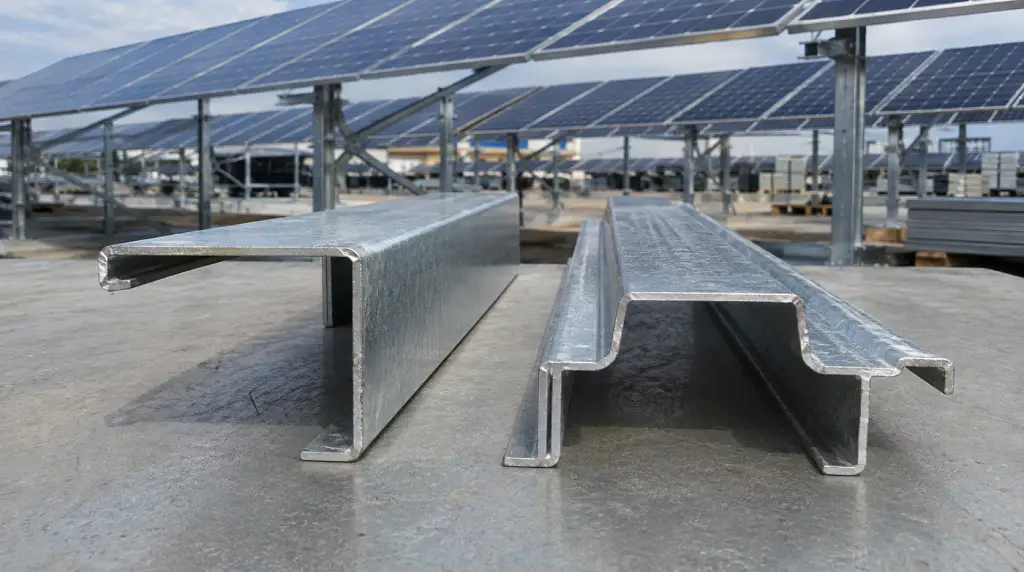
A C purlin is a cold-formed structural section with a cross-section resembling the letter “C”. It normally consists of a web and two flanges and may also include lips at the flange edges depending on the profile design.
C sections are widely used across steel construction because they can be manufactured in different depths, flange dimensions and thicknesses to suit project requirements.
Within solar structures, a C section may be specified as a purlin or as another supporting structural member depending on the MMS design.
Shree Deepak Industries manufactures galvanized C and Z purlins for structural applications in multiple thicknesses and project-specific dimensions.
What Is a HAT Purlin?
A HAT purlin, also called a top-hat section in some specifications, is a cold-formed profile whose cross-section resembles a hat.
The profile typically includes a raised central section with flanges extending outward on both sides. The final dimensions, bends and lips depend on the particular engineering drawing.
In solar module mounting structures, HAT sections are commonly specified as module-supporting purlins in suitable designs.
The relatively different geometry of the HAT profile changes how the section interfaces with the supporting structure and the solar module connection. This is one reason C and HAT sections should not automatically be treated as interchangeable.
C Purlin vs HAT Purlin: Key Differences
| Factor | C Purlin | HAT Purlin |
| Cross-section | Open C-shaped profile | Top-hat shaped profile |
| Typical solar use | Can be used as a purlin or another structural member depending on the MMS design | Often specified as a module-supporting purlin in suitable MMS designs |
| Module / connection interface | Connection depends on flange, web and hole arrangement specified in the drawing | Connection depends on top surface, flanges and hole pattern specified in the drawing |
| Section dimensions | Web, flange, lip and thickness vary by project requirement | Height, top width, flange dimensions, lips and thickness vary by project requirement |
| Manufacturing method | Generally manufactured through cold roll forming | Generally manufactured through cold roll forming |
| Material | Depends on project specification | Depends on project specification |
| Can one directly replace the other? | No. Any profile substitution should be reviewed and approved through the project engineering process. | |
1. Difference in Profile Geometry
The most visible difference between a C and HAT purlin is their cross-sectional shape.
A C section has an open profile with one web and two projecting flanges. A HAT section has a raised central portion with material extending outward on both sides.
That difference affects more than appearance. Section geometry influences structural properties, connection locations, the surfaces available for module fixing and the way the member interacts with the rest of the solar mounting structure.
For this reason, specifying only “C purlin” or “HAT purlin” is not sufficient for manufacturing. The drawing should define the full cross-section.
2. Difference in Structural Role
C sections can be used in several positions within a solar MMS depending on the engineering design. In different systems they may be specified as purlins, columns, rafters, bracing members or other supporting profiles.
HAT sections are frequently used closer to the solar modules as purlins, although their final structural role is again determined by the project design.
This means two solar structures can use completely different combinations of C and HAT profiles while both remaining technically valid designs.
Procurement teams should therefore follow the approved bill of materials and structural drawings rather than trying to standardize every solar project around one profile type.
3. Difference in Module Connection Arrangement
Purlins do more than carry loads. They also form part of the interface used to secure the module or module-fixing system.
With a C section, the fixing arrangement may use the web, flange or another specified connection detail.
With a HAT section, the module-supporting connection may be arranged around the upper part of the profile or another engineered fixing location.
The correct arrangement depends on the design of the MMS and the selected module-fixing method.
Hole location, slot geometry and edge distances should therefore be taken directly from the approved fabrication drawing.
4. Difference in Section Dimensions
Neither C purlins nor HAT purlins come in one universal solar size.
A C section may be defined by parameters such as:
- Web depth
- Flange width
- Lip size where applicable
- Steel thickness
- Member length
A HAT section may similarly be defined by:
- Overall profile height
- Top width
- Side dimensions
- Bottom flange width
- Lip or edge geometry
- Steel thickness
- Member length
Two sections with the same thickness can still behave differently because their geometries are different.
This is why section selection should be based on structural calculations rather than thickness alone.
5. Difference in Connection With Rafters and Other Members
The connection between the purlin and its supporting rafter must match the geometry of both members.
A C purlin may require a different hole pattern or bracket arrangement from a HAT purlin. If one profile is replaced with another without redesigning the connection, the holes may no longer align and the load path may change.
Any proposed profile substitution should therefore consider:
- Member geometry
- Connection location
- Bolt arrangement
- Hole size and pitch
- Supporting member geometry
- Required clearances
- Structural calculations
Where Are C Purlins Used in Solar Structures?
C purlins can be suitable for several structural roles when specified by the engineer.
Depending on the project design, a C section may be used for:
- Module-supporting purlins
- Rafters
- Columns or posts
- Bracing members
- Supporting frames
- Other cold-formed structural members
The broad versatility of C sections is one reason they appear frequently in both solar and conventional structural applications.
However, a C section designed for an industrial shed should not automatically be assumed suitable for a solar MMS. Solar projects can have different loads, spans, connections and environmental exposure requirements.
Where Are HAT Purlins Used in Solar Structures?
HAT sections are commonly used as purlins positioned directly below or close to the solar modules in suitable MMS configurations.
The profile can provide a defined supporting surface for module connections while remaining compatible with cold-form manufacturing methods.
However, the actual HAT profile should still be engineered for the project. Its dimensions, steel thickness, material grade, connection pattern and span should be defined by the structural design.
A generic HAT profile should not be ordered simply because another solar project used a visually similar section.
Is a C Purlin Stronger Than a HAT Purlin?
There is no responsible universal answer to this question.
The structural capacity of a cold-formed steel section depends on much more than whether its cross-section is C-shaped or HAT-shaped.
Relevant factors include:
- Section dimensions
- Steel thickness
- Material grade
- Yield strength
- Span
- Support conditions
- Connection configuration
- Applied loads
- Local and overall buckling behaviour
A properly engineered HAT section may be appropriate for one loading condition, while a C section may be appropriate for another.
Comparing the profiles only by shape or thickness can therefore be misleading.
Is a HAT Purlin Lighter Than a C Purlin?
It can be, but this should not be assumed.
The weight of a section depends on its developed strip width, thickness, length and material density. A thin HAT profile may weigh less than a larger C section, but a different HAT design could use more material.
For procurement purposes, compare the actual approved section weights rather than assuming that one profile category is always lighter.
Materials Used for C and HAT Purlins in Solar Projects
Both profiles can be manufactured from steel coils selected according to project requirements.
Depending on the design, specifications may call for galvanized steel, aluminium-zinc coated steel or another approved coated material.
The material requirement should define more than the generic term “GI”. Where relevant, the purchase specification should identify:
- Steel grade
- Material thickness
- Coating type
- Required coating specification
- Mechanical properties
- Documentation or traceability requirements
Shree Deepak Industries lists GP, Zincalume and colour-coated slit coils in multiple thicknesses and widths for solar structures and other industrial applications.
How Are C and HAT Purlins Manufactured?
Both profiles are commonly manufactured using cold roll-forming processes.
A typical production sequence may include:
- Reviewing the approved section drawing
- Selecting the required steel coil
- Slitting the coil to the required developed width
- Setting up the roll-forming tooling
- Forming the strip into the required profile
- Punching holes or slots as specified
- Cutting the member to length
- Checking dimensions and hole positions
- Bundling and identifying the finished members
The exact process depends on the material, profile design, equipment and project specification.
Shree Deepak Industries’ solar structure manufacturing capabilities include C, Z and HAT profile requirements, roll forming, punching considerations, coating protection, quality checks and dispatch planning.
Why Punching Accuracy Matters for Solar Purlins
In large solar projects, the same structural connection can be repeated many times.
If a hole is slightly out of position on one member, that error may be repeated across an entire production batch. The result can be difficult alignment, additional site work or delays during erection.
For both C and HAT purlins, manufacturers should therefore work from clearly approved hole patterns and dimensional tolerances.
Important punching details may include:
- Hole diameter
- Slot dimensions
- Pitch between holes
- Distance from member ends
- Distance from profile edges
- Orientation of elongated slots
How to Select Between C Purlin and HAT Purlin for a Solar Project
The final selection should come from engineering, but EPC and procurement teams can still evaluate whether the manufacturing requirement has been properly defined.
1. Start With the Approved Structural Design
The project drawing should define which profile is required and where it is used.
Do not start by choosing whichever profile is currently cheaper or more readily available and then try to fit it into the existing design.
2. Check the Complete Section Geometry
Confirm every relevant dimension, not just the profile name and thickness.
3. Confirm Steel Grade and Coating
Make sure the material being quoted matches the project specification rather than a generic commercial alternative.
4. Review Connection Details
The profile must integrate with the rafters, brackets, fasteners and module connections shown in the design.
5. Confirm Hole Pattern and Tolerances
Provide fabrication drawings or detailed punching information before manufacturing starts.
6. Consider Manufacturing Repeatability
Large solar projects require consistent profiles across many members. The production process should be able to maintain the required geometry and hole pattern through the complete batch.
7. Consider Site Handling and Installation
Member lengths, bundle identification and connection arrangement can affect how easily the installation team can locate and assemble the correct components.
When Should a C Purlin Be Selected?
A C purlin may be appropriate when the approved MMS engineering specifies a C section for the required structural role.
Selection may depend on the section properties, supporting-member geometry, span, connection arrangement and availability of the required dimensions and material.
Buyers looking for project-specific C sections can review the existing C and Z purlin range from Shree Deepak Industries and share the exact drawing for requirement-based manufacturing.
When Should a HAT Purlin Be Selected?
A HAT purlin may be appropriate when the MMS engineering uses a HAT-shaped section for module support or another defined structural role.
The decision should be based on the engineered cross-section and connections rather than selecting HAT purely because it is commonly associated with solar structures.
Where a custom HAT profile is required, the manufacturer should receive the complete section drawing, material requirement, length schedule and punching details before production.
Can a C Purlin Be Replaced With a HAT Purlin?
Not without technical review.
Changing from C to HAT—or HAT to C—changes the geometry of the structural member. That can influence section properties, connection locations, hole patterns, module interface and overall structural behaviour.
If a substitution is being considered because of material availability, cost or manufacturing constraints, it should be referred back to the appropriate engineering team for review and approval.
What Should Be Included in a Solar Purlin RFQ?
Whether the requirement is C purlin or HAT purlin, a clear RFQ helps prevent technical ambiguity.
Where available, provide:
- Profile drawing
- Complete cross-sectional dimensions
- Steel grade
- Thickness
- Coating requirement
- Member lengths
- Hole and slot details
- Quantity or total tonnage
- Part identification requirements
- Inspection requirements
- Documentation requirements
- Packing instructions
- Delivery location
For large projects, a bill of materials and approved fabrication drawings can make quotation and production planning more accurate.
Common Procurement Mistakes With Solar Purlins
Ordering by Profile Name Alone
“C purlin” or “HAT purlin” does not provide enough information for project-specific manufacturing.
Comparing Only Thickness
Two 1.5 mm profiles can have very different section geometry and structural properties.
Assuming C and HAT Are Interchangeable
They are different profiles and may require different structural and connection designs.
Ignoring Hole Pattern
Correct profile dimensions alone do not guarantee that a member will fit at site if its punching pattern is incorrect.
Changing Material Without Approval
A different steel grade or coating should not be substituted merely because it is commercially available.
How Shree Deepak Industries Supports Solar Purlin Requirements
Shree Deepak Industries is based in Jaipur, Rajasthan, and its website presents capabilities in solar structure manufacturing using C, Z and HAT profile requirements along with precision roll forming, punching considerations, coating protection, quality checks and dispatch planning.
The company’s live product range includes galvanized C and Z purlins and slit coils for solar and industrial applications.
The final purlin profile for any solar project should be manufactured according to the approved engineering drawing rather than selected from a generic profile description.
If you have a C purlin, HAT purlin or other solar structure profile requirement, share the profile drawing, thickness, quantity, punching details and delivery location with Shree Deepak Industries for review.
Frequently Asked Questions About C and HAT Purlins
What is the main difference between a C purlin and a HAT purlin?
The main difference is the profile geometry. A C purlin has an open C-shaped cross-section, while a HAT purlin has a top-hat-shaped section. This affects section properties, connection arrangements and how the profile is integrated into the solar mounting structure.
Which purlin is better for solar structures: C or HAT?
Neither profile is universally better. The correct selection depends on the structural design, loads, member span, material specification and connection arrangement of the particular solar project.
Can C purlins be used in a solar module mounting structure?
Yes. C sections can be used as purlins and may also be specified for columns, rafters or other supporting members depending on the MMS design.
What is a HAT purlin used for in solar structures?
HAT sections are commonly used as module-supporting purlins in suitable module mounting structures. Their dimensions and connections should follow the project engineering drawings.
Can a HAT purlin replace a C purlin?
Not automatically. The profiles have different geometries and structural properties, so any substitution should be reviewed and approved by the appropriate engineering team.
What material is used for solar purlins?
Solar purlins may be manufactured from galvanized steel, aluminium-zinc coated steel or another project-approved material depending on the structural and corrosion-protection requirements.
Why are hole patterns important in solar purlins?
Purlins connect repeatedly to modules, rafters or other MMS members. Accurate hole and slot positions help those components align correctly during site assembly.
What details are needed when ordering a custom HAT purlin?
Provide the full cross-sectional drawing, material grade, thickness, coating requirement, member length, punching pattern, quantity and any applicable dimensional tolerances.
Share thickness + size + quantity — we’ll reply with the best option.